Author: fervor_admin

CommonSpirit Health Leads in Improving Quality and Outcomes for Patients while Reducing Medicare Spending by $136 Million

CommonSpirit Health, one of the nation’s largest providers of value-based care, announced today that it delivered improved quality and $136 million in savings to Medicare for the 2020 performance year of the Medicare Shared Savings Program (MSSP).

Read the Press Release

How an Outreach Team is Making a Difference to Support AWV Initiative

CommonSpirit Health Accountable Care Organizations have been focused on annual wellness visits (AWVs) as an enterprise-wide initiative, successfully increasing the number of Medicare beneficiaries who receive them, but there’s still room for improvement. Ranae Forbes, Director of Clinical Program Support at Dignity Health Medical Foundation, has identified an outreach strategy that’s driving AWVs while lightening the workload for clinicians.

The Value of AWVs

AWVs are a critical pathway to identifying high-risk patients and helping them to develop personalized prevention plans to prevent illnesses. They also serve as a valuable tool to ensure appropriate quality gaps are closed.

Medicare Part B patients are eligible for one free annual wellness visit every 12 months, and ensuring that patients receive them can help improve their quality of life and lower their health care costs. Studies show a 5.7% reduction in adjusted total health care costs and up to 79% greater performance on certain clinical quality measures. Patients who get an AWV also are more likely to receive recommended preventive clinical services like screenings for fall risk, colorectal cancer and breast cancer, as well as depression screening and follow-up, and tobacco screening and cessation.

Streamlining the Process

While AWVs provide numerous benefits, the time associated with conducting the AWV in an already busy practice environment has been a challenge in increasing the volume of AWVs provided to patients. Forbes’ new outreach team is stepping in to provide support by contacting patients to schedule their AWV and document answers on the AWV questionnaires in advance of their visit.

“We’re a centralized outreach team, and we’re contacting patients all over the state,” she says. “We’re getting answers to as many of those questions as possible during our pre-visit phone calls so that when the patient comes in, the medical assistant only needs to confirm there are no changes needed.”

Making Steady Progress

The data is already reflecting an increase in AWVs in their market for both Medicare FFS and Medicare Advantage beneficiaries. DHMF provided 9,498 AWVs in 2020, or 17% of the eligible population, which is an increase from 6,779 in 2019, or 12%. They are targeting to reach 15,500 patients in 2021 and are well on track. Halfway through the year, they are at 7,700 patients with completed AWVs.

“I think we’re capturing a lot of patients who otherwise would not come in the door, and we’re really having an impact on their health,” Forbes says.

Secrets to Success

What can other markets learn from DHMF’s success? Forbes offers a few key recommendations.

  1. Create a playbook in partnership with clinics, where a maximum number of appointments per day or week is agreed on so that clinicians and staff are not overwhelmed by a flood of appointments.
  2. Assign staff/a team to complete the pre-appointment questionnaires. Completing as much documentation as possible on the pre-visit phone calls lightens the workload of the providers and streamlines the AWV process.
  3. Ensure the patient hasn’t already completed their AWV for the year. The visits are covered only once a year, so make sure the pursuit lists are up to date and confirm with the patients their last AWV visit was at least 11 months prior.

“Seeing our patients annually is key to ensuring that their health is being monitored,” Forbes says. “In this 65+ population, 51% have a chronic condition. So unless we ensure we’re capturing them annually, we may miss those chronic conditions and that could really impact their health.”

If you’d like to learn more about DHMF Outreach Program, please contact Ranae Forbes at Ranae.Forbes@commonspirit.org. For general questions about the AWV initiative at CommonSpirit Health, please reach out to Dr. Melissa Gerdes at Melissa.Gerdes@commonspirit.org.

Healthcare executives call on Biden to take ‘innovative, bold’ steps to tackle health equity using AI, big data

According to Fierce Healthcare, during Reuters’ Digital Health 2021 virtual event, Alisahah Cole, M.D., system vice president of population health innovation and policy at CommonSpirit Health, said that COVID-19 placed a clear strain on the health system’s infrastructure, particularly when it came to public health agencies’ ability to collect and analyze patient data from a wealth of different sources. Dr. Cole also said that, at the same time, structural racism and other issues related to social determinants of health have exacerbated outcomes across certain patient populations while driving up costs for individuals, health organizations and the broader public. Dr. Cole added that it is not a lack of data that is the issue, but rather the analysis and what to do with the data.

Read the Article

Vaccination Is a Racial Justice Issue

COVID-19 has left no community untouched. But its disproportionate impact on our most vulnerable populations — particularly communities of color — is well documented. Sadly, this holds true across the nation and in California, where the death rate is 22% higher for Latino people and 8% higher for Black people than the overall statewide death rate, and the COVID case rate is 32% higher for Pacific Islanders. COVID case rates for poorer communities — those with a median household income below $40,000 — have been 37% above statewide rates as well.

For these communities, health disparities and mistreatment aren’t new. Historical and systemic racism has, and continues to, exclude people of color from accessing health care and social services. The cultural identities and the language of communities of color have been threatened for decades. That experience has been compounded by community leaders and elders being disproportionately affected by COVID, making the need to proactively protect their cultural identity and heritage even greater. And California’s immigrant communities, which have faced these inequities throughout their history, have been forced to choose between their jobs and their health during the pandemic. As vaccination efforts continue, these communities still face a lack of equity in distribution, though availability is on the rise across the population.

Understanding Hesitancy

From the Tuskegee Syphilis Experiments and the use of Henrietta Lacks’ cancer cells without consent or compensation to the forced sterilization of women of color, a history scarred by systemic racism, exclusion and trauma has led to an understandable distrust of health care delivery systems within communities of color.

But through education and more awareness of the vaccine, hesitancy rates in the U.S. are dropping, and the latest U.S. Census data shows people of color aren’t more hesitant to get the vaccine than the rest of the population. Researchers found that approximately 12% of Black and white adults were equally concerned about getting it, compared with 10% of Hispanic adults who felt similarly.

Despite this good news, we’ve observed that vaccine distribution has not been equitable, and community and health care leaders across the country have been working together to pop up vaccine clinics in communities of color, offer more walk-in appointments to improve access and find other strategies to ensure a more equitable distribution.

An Opportunity to Promote Equity

As dire as the circumstances of this pandemic have been, we are strengthened by the knowledge that we have an opportunity to ensure health equity for all Americans. Many leaders across multiple sectors have joined in this fight, providing proactive outreach in communities that have been disproportionately affected, historically disenfranchised or have more limited access to health care.

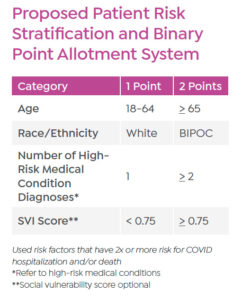
At CommonSpirit Health, we’ve been leading the effort to develop a vaccine outreach prioritization matrix. While some outreach is afforded to all patients, this tool focuses additional and more intensive outreach to populations at higher risk (as defined by the CDC) from COVID-19 infection.

We asked leaders in our markets throughout the U.S. to consider adopting this evidence-informed tool to guide their outreach planning and programming. All patients should receive some communication, with at-risk individuals scoring higher on this scale receiving intentional outreach. This outreach should include culturally competent education/awareness, helping patients make a plan to get their vaccine (and navigate the sometimes-confusing registration processes), and support in addressing potential barriers and/or hesitancy to vaccination.

One of my favorite quotes from Martin Luther King Jr. is: “Of all the forms of inequality, injustice in health care is the most shocking and inhumane.” If we want to move past this pandemic and work toward a stronger, more equitable health care delivery system, we must ensure that everyone has the same opportunity to access this lifesaving vaccine.

Supporting the Community with Pride

CommonSpirit Health is dedicated to being inclusive and welcoming to all people, including our LGBTQ employees, patients and community members. In recognition of Pride this month, CommonSpirit Population Health welcomes the opportunity to honor our LGBTQ patients, the millions of LGBTQ people in the communities we serve and the many LGBTQ members of the Population Health family.

Population Health is dedicated to improving health care and promoting health equity. While it’s important to celebrate the substantial progress toward LGBTQ equality that our country has made in recent years, we recognize that LGBTQ inequities and disparities persist, from homelessness among LGBTQ youth to heightened anxiety and depression due to discrimination as well as discrimination against transgender and gender-expansive people. In partnership with our care providers, Population Health supports a welcoming environment for LGBTQ patients that is respectful of their identity and health care needs, and we’re dedicated to continuing our work to help put an end to these inequities and disparities.

Throughout this month—and every month—we will be reaffirming our commitment to our employees and patients who identify either as part of or as allies of the LGBTQ community. And our steadfast commitment to our LGBTQ employees and patients remains the same: that every day, you feel you are welcome here.

Vaccinating Kids Ages 12—15 an Important Step Toward Normal

The COVID-19 pandemic has put serious demands on our children – stay away from friends, stay away from school and activities, stay away from grandparents. Attend classes online (and actually learn!). And in too many households, children are struggling to understand the loss of a loved one or what’s happening if a parent has endured a job loss due to COVID.

Read More

CommonSpirit Health Adopts Telehealth Services for Opioid Treatment

CommonSpirit Health has launched a clinical partnership with BrightHeart Health to offer telehealth services for medication-assisted treatment (TeleMAT) for patients with opioid use disorder.

Read More

Changing lives in Arizona at the Center for Transitional Care

The Center for Transitional Care in Arizona is helping patients stay healthy, significantly reducing readmission rates among high-risk patients and yielding cost savings of $8.4 million in the process.

Watch the Video

Jessica Dixon Honored with Two Marketing Industry Awards

Congratulations to Jessica Dixon, System Director, Marketing & Communications, Population Health, who recently earned two prestigious marketing industry honors. Dixon was named one of the Top Women in Communications for 2021 by Ragan and PR Daily, an award that recognizes influential women who are making a significant impact in their jobs and advancing the communications profession.

In addition, Dixon earned a platinum award for individual achievement in the Hermes Creative Awards. She was honored for her body of work as a creative and strategic marketing leader and the impact of that work on the enterprise. Judges consider both stated goals and results for marketing programs as well as creative work samples.

“I’m so pleased that the industry recognizes Jessica for what we all know well and appreciate at CommonSpirit Population Health,” says Kathy Bristow, System VP, Operations and Integration, Population Health. “Jessica elevates Population Health’s mission and effectively constructs priorities and ideas that bring our communities together. She exemplifies the leadership needed in an environment of rapid change, and we rely on her to keep us on message and impactfully represent the work of the diverse teams across the ministry.”

Congratulations, Jessica!

J. Bianca Roberts, MD: Caring Begins in Her Own Community

For J. Bianca Roberts, MD, Family Medicine/Occupational Health and Walk-In Clinic Department Chair at Mercy Medical Group (MMG), Dignity Health, ensuring that the most vulnerable members of her community receive the COVID-19 vaccine is a goal that’s both professional and personal.

Originally from south Sacramento, Dr. Roberts has been with Dignity Health since 2013, and

the ZIP code she grew up in has become one of the hardest hit by COVID-19. Members of her family live in these vulnerable communities.

“I feel so grateful to work in a group that recognizes the importance of not just taking care of our own patients but our community as well,” she says. “That’s the reason I joined Mercy Medical Group; it was always my goal to take care of underserved populations and take care of the community I grew up in.”

Aiming for Equitable Vaccine Distribution

Dr. Roberts serves on her market’s COVID-19 Vaccine Task Force, which has met regularly throughout the pandemic to review COVID-19 safety and treatment protocols. When the vaccine became available and they learned they’d be receiving an allocation, the task force worked to create plans for distribution.

The group identified four sites throughout the Sacramento area to distribute large amounts of vaccine doses in a short amount of time. Then they began calling their most vulnerable patients — those over age 65 with medical conditions that put them at highest risk, per county eligibility guidelines.

“We started by calling MMG patients,” Dr. Roberts says. “That was key because we felt that our sickest patients weren’t going to have the information and the ability to schedule on their own.”

Adjusting Their Strategies

When county and state officials changed how the vaccine can be accessed by requiring individuals to sign up for My Turn, it created obstacles for the task force and the vulnerable communities they’re working to reach.

“With My Turn, vulnerable communities were affected because those spots fill up with the people with the fastest internet and those who speak English, for example,” she says. “That’s one of the reasons the vaccine hasn’t reached vulnerable patients.”

MMG continues to reserve as many appointments as possible for vulnerable populations, who can call a secure phone number to schedule an appointment. They also are partnering with the community to help those who aren’t MMG patients access the vaccine and give the secure number to community-based organizations.

The Work Continues

Beyond the task force, Dr. Roberts is aiding in vaccine distribution via other avenues. She partnered with the NAACP in advocating for vaccine equity, setting up a health line and providing African American churches with information about vaccine clinics. And she and her colleagues have been volunteering with the county and supporting pop-up clinics in some of the most impacted areas, where people can walk up to get a vaccine, as well as working to distribute the vaccine to homeless populations. She’s quick to highlight the efforts of others as well:
 

  • Cecilia Divin is conducting a variety of community clinics with Dignity Health, aiming to reach underserved Latino communities.
  • Physicians across medical systems are working to ensure other providers know where the vaccines are, so when they see patients they can direct them to those resources. Dignity Health has been working with UC Davis in this effort.
  • Twenty-five Black physicians from various medical groups in Sacramento recently partnered with the NAACP, working with the governor’s office on vaccine equity, in response to the recognition that the vaccine isn’t reaching the communities that need it most.
  • The Association of Black Nurses contacted MMG to offer support, and MMG looks forward to working with their volunteers at future community vaccine events. “Having a diverse medical staff come to your community to vaccinate you speaks volumes,” Dr. Roberts says.

Education Resolves Hesitancy 

As for questions about vaccine hesitancy, that’s an easier problem to solve, says Dr. Roberts.

“When the community is educated about the vaccine, the hesitancy goes away,” she says.

To address hesitancy, Dr. Roberts has been participating in Facebook Live events with physicians around the country. She’s also done one with the CME Church in Oakland, as well as a Town Hall with the NAACP to discuss what’s in the vaccine, how it works, its effectiveness and the inclusion of Black people in the vaccine studies.

For those who’ve seen what this virus can do, access is the biggest issue. “Many have had family members die of COVID,” she says, “and they just want the vaccine.”